
Non-Combustible, Fire-Rated, CodeMark: What Cladding Fire Terms Actually Mean
Cladding fire terms explained
Non-combustible describes a material’s combustibility, fire-rated usually refers to a building element’s fire-resistance performance, and CodeMark provides evidence of suitability for specified National Construction Code (NCC) requirements. They answer different questions, so none should be treated as a substitute for the others or as blanket approval for a facade.
When you’re comparing cladding documents, the distinction matters. A material test, a wall-system classification and a certificate can all provide useful evidence, but they don’t describe the same thing. This glossary explains the terms behind that evidence, including what HVG Facades’ published product documents record.
Is cladding fireproof?
“Fireproof” isn’t the NCC term to use when describing cladding performance. The NCC uses defined terms such as non-combustible, fire-resisting and fire-resistance level, each tied to a particular property or requirement. Calling a panel fireproof blurs those distinctions and suggests an absolute assurance that a specific test result doesn’t provide.
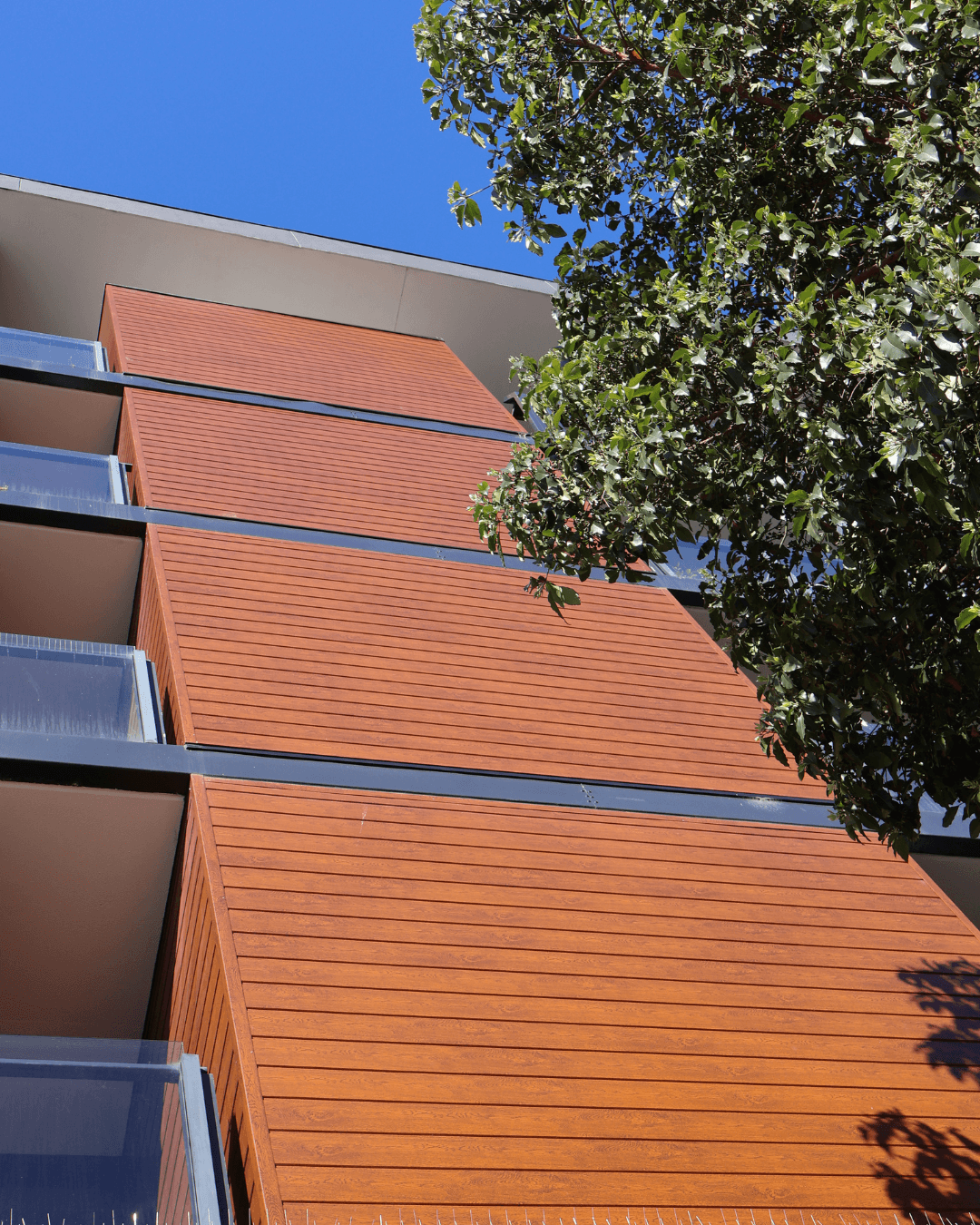
Non-combustible and combustible cladding
For a material, the NCC definition of non-combustible refers to a determination under AS 1530.1. Applied to construction or part of a building, it means construction wholly of materials that aren’t deemed combustible. The NCC also identifies particular materials that may be used where non-combustible materials are required. That permitted-use provision is a different statement from reporting a material’s test result.
Combustible is also a defined term, not simply a description of a product that looks flammable. For materials, it relates to AS 1530.1; for construction, it means construction wholly or partly of combustible materials.
Is aluminium non-combustible? Start with the documented product, not just the material name. A solid aluminium panel and a bonded aluminium panel have different constructions. The evidence for the specified panel, coating and relevant components matters more than a general statement about aluminium.
HVG Facades’ non-combustible cladding range includes different materials and constructions, so their supporting documents should be read individually.
Fire-rated, fire-resistant and fire-resistance level
“Fire-rated” is commonly used shorthand, but it needs an accompanying rating and scope to be useful. The NCC defines a fire-resistance level (FRL) using three criteria, expressed in this order:
- Structural adequacy: the structural criterion.
- Integrity: resistance to the passage of flames and hot gases.
- Insulation: limiting temperature rise on the unexposed surface.
The grading periods are expressed in minutes. An FRL of 60/60/60 identifies 60 minutes for each criterion under the applicable assessment conditions, not a promise about every possible fire. A dash means that criterion has no requirement.
The NCC term fire-resisting, applied to a building element in Volume One, means it has an appropriate FRL. “Fire-resistant” on its own is less precise: ask which property, test or rated construction the description refers to. A non-combustible cladding panel doesn’t acquire an FRL simply by passing a combustibility test.
AS 1530.1: combustibility testing
AS 1530.1 is the combustibility test for building materials. Standards Australia describes it as one of a series of methods for evaluating the potential fire hazard of building products. It addresses a material’s response under specified test conditions. It doesn’t assign a wall a fire-resistance level or describe how a complete facade assembly will perform in a large-scale fire test. A published AS 1530.1 result should therefore stay attached to the material and scope it covers, rather than becoming a claim about every installation.
AS 1530.3: early fire hazard indices
Commonly shortened to AS 1530.3, AS/NZS 1530.3 grades materials on ignition tendency, flame spread, heat development and smoke production. These are separate indices, not one overall fire rating. A zero ignitability or flame-spread index describes that measured response under the test conditions. It doesn’t mean the material has a zero smoke index, and it isn’t a substitute for an AS 1530.1 combustibility determination. Nor does it establish a fire-resistance level in minutes. This is why the individual numbers matter. “Zero flame spread” and “zero across all fire indices” aren’t interchangeable descriptions.
AS 5637.1: internal wall and ceiling lining classifications
AS 5637.1 sets out procedures for assessing the fire hazard properties of internal wall and ceiling linings, including the determination of a Group Number. It considers how linings contribute to fire growth, including ignition, heat release, smoke release and the tendency to cause flashover. A Group Number classification relates to internal lining applications. It isn’t an AS 1530.1 combustibility result, a fire-resistance level or evidence of external wall system performance. Read the product’s assessment for the classification, application and conditions it covers.
AS 5113: external wall fire performance
AS 5113 addresses the classification of external walls based on reaction-to-fire performance. Unlike an individual material test, it uses large-scale testing to assess a wall system’s tendency to spread fire. The external wall classification is commonly identified as EW. The result relates to the assessed wall system, not automatically to every assembly containing the same panel. It also doesn’t turn the components into non-combustible materials or give them an FRL. The ABCB explicitly cautions that achieving EW classification alone doesn’t automatically demonstrate NCC compliance.
AS 1530.1: combustibility testing
AS 1530.3: early fire hazard indices
AS 5637.1: internal wall and ceiling lining classifications
AS 5113: external wall fire performance
AS 1530.1 is the combustibility test for building materials. Standards Australia describes it as one of a series of methods for evaluating the potential fire hazard of building products. It addresses a material’s response under specified test conditions. It doesn’t assign a wall a fire-resistance level or describe how a complete facade assembly will perform in a large-scale fire test. A published AS 1530.1 result should therefore stay attached to the material and scope it covers, rather than becoming a claim about every installation.
Commonly shortened to AS 1530.3, AS/NZS 1530.3 grades materials on ignition tendency, flame spread, heat development and smoke production. These are separate indices, not one overall fire rating. A zero ignitability or flame-spread index describes that measured response under the test conditions. It doesn’t mean the material has a zero smoke index, and it isn’t a substitute for an AS 1530.1 combustibility determination. Nor does it establish a fire-resistance level in minutes. This is why the individual numbers matter. “Zero flame spread” and “zero across all fire indices” aren’t interchangeable descriptions.
AS 5637.1 sets out procedures for assessing the fire hazard properties of internal wall and ceiling linings, including the determination of a Group Number. It considers how linings contribute to fire growth, including ignition, heat release, smoke release and the tendency to cause flashover. A Group Number classification relates to internal lining applications. It isn’t an AS 1530.1 combustibility result, a fire-resistance level or evidence of external wall system performance. Read the product’s assessment for the classification, application and conditions it covers.
AS 5113 addresses the classification of external walls based on reaction-to-fire performance. Unlike an individual material test, it uses large-scale testing to assess a wall system’s tendency to spread fire. The external wall classification is commonly identified as EW. The result relates to the assessed wall system, not automatically to every assembly containing the same panel. It also doesn’t turn the components into non-combustible materials or give them an FRL. The ABCB explicitly cautions that achieving EW classification alone doesn’t automatically demonstrate NCC compliance.
NCC cladding fire requirements: the compliance pathways
The NCC sets Performance Requirements. At a high level, these can be satisfied through a Deemed-to-Satisfy Solution, a Performance Solution, or a combination of both. Compliance also requires meeting the NCC’s Governing Requirements.
A Deemed-to-Satisfy Solution follows the relevant prescriptive provisions. A Performance Solution demonstrates that the relevant Performance Requirements are met, or that the solution is at least equivalent to the Deemed-to-Satisfy Provisions, using the permitted assessment process. It isn’t permission to bypass fire requirements.
For November 2026 publication, there isn’t one NCC edition uniformly in force across Australia. NCC 2025 has been published, but adoption dates, transitions and variations differ by jurisdiction. NCC 2022 remains relevant where that edition applies. The applicable edition and local provisions must be established for the project. For more detail, see our guide to NCC 2025 facade compliance and what changes by state.
CodeMark: certification with a defined scope
CodeMark is a voluntary third-party building product certification scheme administered by the ABCB. A Certificate of Conformity is one option for meeting the NCC’s evidence-of-suitability requirements for a product used in specified circumstances. It’s not a separate fire test or a universal approval for every application.
Read the certificate’s product description, NCC provisions, conditions and limitations. Check its current status through the register linked by the ABCB, rather than relying on a logo or an old download. Certificates can be amended or withdrawn, and acceptance obligations depend on jurisdictional arrangements.
What HVG Facades’ published specifications record
The documents below illustrate why different evidence needs different wording. The indices are reproduced as published, not converted into broader performance claims.
MondoClad solid aluminium panels
April 2026 fixed watertight cassette specification. AS 1530.1: Passed. AS 1530.3: ignitability 0, flame propagation 0, heat release 0, smoke release 0–1. AS 5637.1: refer to the product’s assessment for its Group Number classification and scope for internal wall and ceiling lining applications.
Nucleo bonded aluminium panels
September 2023 Rev1 fixed watertight cassette specification. AS 1530.1: Passed. AS 1530.3: ignitability 0, flame propagation 0, heat release 0, smoke release 0–1. AS 5637.1: refer to the product’s assessment for its Group Number classification and scope for internal wall and ceiling lining applications.
Zintl interlocking aluminium cladding
V1 specification. AS 1530.1: Pass. For both listed woodgrain and standard powdercoat finishes, AS 1530.3 indices are ignitability 0, spread of flame 0, heat evolved 0 and smoke developed 3. Zintl’s specification also retains an NCC 2019 reference and instructs readers to check that the finish was applied before AS 1530.3 testing. Those details shouldn’t be silently updated or transferred to its separate batten range.
Vetérro through-coloured fibre cement
September 2026 V7.0 brochure’s technical data sheet. Fibre-reinforced cement sheeting is permitted wherever a non-combustible material is required under NCC 2025 Volume One C2D10(6)(d), without needing an AS 1530.1 combustibility test to establish that permitted use.
MondoClad solid aluminium panels
Nucleo bonded aluminium panels
Zintl interlocking aluminium cladding
Vetérro through-coloured fibre cement
April 2026 fixed watertight cassette specification. AS 1530.1: Passed. AS 1530.3: ignitability 0, flame propagation 0, heat release 0, smoke release 0–1. AS 5637.1: refer to the product’s assessment for its Group Number classification and scope for internal wall and ceiling lining applications.
September 2023 Rev1 fixed watertight cassette specification. AS 1530.1: Passed. AS 1530.3: ignitability 0, flame propagation 0, heat release 0, smoke release 0–1. AS 5637.1: refer to the product’s assessment for its Group Number classification and scope for internal wall and ceiling lining applications.
V1 specification. AS 1530.1: Pass. For both listed woodgrain and standard powdercoat finishes, AS 1530.3 indices are ignitability 0, spread of flame 0, heat evolved 0 and smoke developed 3. Zintl’s specification also retains an NCC 2019 reference and instructs readers to check that the finish was applied before AS 1530.3 testing. Those details shouldn’t be silently updated or transferred to its separate batten range.
September 2026 V7.0 brochure’s technical data sheet. Fibre-reinforced cement sheeting is permitted wherever a non-combustible material is required under NCC 2025 Volume One C2D10(6)(d), without needing an AS 1530.1 combustibility test to establish that permitted use.
Get the evidence behind the term
The useful distinction is between material behaviour, wall-system performance and evidence supporting a particular use. Keeping those separate makes technical documentation easier to read without asking a single result to answer every question.
For product documentation and cladding compliance support, contact the HVG Facades technical team. They can supply the relevant reports and specifications for review by your project’s responsible professionals.